
Open access · Scholarly publishing
Research, open to everyone.
Books that bring research into the world. Explore scholarly work, freely available to read, download and share.
Free to read and downloadPeer-reviewed publishingAuthor-retained copyright
Published books
View all books →About the press
Knowledge without barriers.
OA Books is a project of the Canadian Center of Science and Education, publishing books, conference proceedings, monographs, biographies, theses as books, and papers in books.
Discover OA Books →Announcements
News and archived announcements, with their original publication dates.
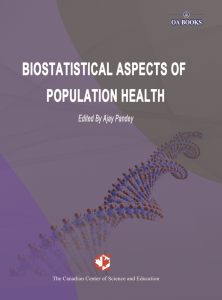
Announcement of New Publication: "Biostatistical Aspects of Population Health"
We are delighted to announce the publication of "Biostatistical Aspects of Population Health," edited by Dr. Ajay Pandey. This comprehensive book explores the development of new estimation procedures and analytical techniques aimed at simplifying complex public health phenomena.
The book features contributions from renowned experts who present empirical evidence supporting new methodologies in public health statistics. Key topics include:
- Multilevel Estimation Procedures: Examining household and village environmental factors affecting disease prevalence in northeastern India.
- Neonatal Survival: Demonstrating significant gains in neonatal survival rates among mothers adhering to recommended birth intervals.
- Bayesian Estimators: Highlighting the superiority of Bayesian estimators in predicting infant mortality.
- Post-Partum Amenorrhea: Statistical models assessing the distribution and implications for family planning strategies.
- Speed of Aging: Alternative methods for estimating the rate of aging in populations.
- Infectious Disease Modeling: Advanced models for understanding the spread of epidemics.
- Low Birth Weight: Identifying predictors and prevalence patterns among adolescent mothers.
- Gender Preferences: Insights into son preference and its implications for reproductive health.
To access "Biostatistical Aspects of Population Health," please visit Biostatistical Aspects of Population Health.
Call for Monographs
OA Books is a project innovated by the Canadian Center of Science and Education (CCSE). We focus on publishing open-access books in various research disciplines of the social sciences and humanities. We are looking for original, unpublished works to publish.
Learn more about OA Books and submit your manuscript by e-mail to oabooks@ccsenet.org.
From Ph.D. Thesis to First Book
If you have finished your Ph.D. you are probably thinking of turning your dissertation into a book. Your Ph.D. thesis usually becomes your first monograph and helps you to start building a reputation in the academic world.
Turning your doctoral thesis into a publishable book will require some adjustments and adaptation of the content and style. Although there is no single rule that can guide you in the process of getting a publishable book out of your Ph.D., some elements usually distinguish a typical doctoral thesis from a monograph.
Below we provide some useful hints.
The Four Qualities of a Book
Turning your doctoral thesis into a book will require you to re-edit the text of your dissertation and revise its style. Your book will probably need to be more:
- personal
- focused
- essential
- readable
Dissertation
- Fulfils an academic requirement
- Audience: one’s dissertation committee
- Dependent on quotations, often in blocks
- Hides the authorial voice
- Structure demonstrates analytical skills
- Examples are numerous, repetitive
- Few, long chapters
- Stops
Book
- Fulfils a desire to speak broadly
- Audience: thousands of people you don’t know
- Quotes others judiciously
- Creates and sustain an authorial voice
- Structure demonstrates the throughline
- Examples are well-chosen and move the story forward
- Several chapters of readable length
- Concludes
- Never assume that even an award-winning dissertation is already a scholarly book
- Never assume that a publisher or a reader will treat a first book as a practice exercise
- Never submit a manuscript to more than one publisher at the same time unless you have received the consent of each to a multiple submission
- Never conceal from a potential publisher arrangements you have already made for the publication of chapters in journals or in edited volumes
- Never send a manuscript to a publisher unless you have been asked to do so
- Never assume that an award-winning scholarly book couldn’t have begun as a dissertation
The title is the first thing a potential reader/buyer will get to know about your book. It will have to address in a direct and essential way the main content of your work within a specific discipline. For this reason, the title of your book will normally be shorter than your PhD's.
BlurbWhat is the abstract of your thesis needs to become the blurb of a commercial book. The blurb usually ends up on the back-cover. It is important that you present your work in a catchy way to capture your potential reader’s attention.
Before writing the blurb you should consider:
- If there is a word limit (usually 250-300 words)
- If you have to clear it with your sponsoring academic committee
- If the publisher has the right to amend it prior to final publication
- If your personal and biographical data are up-to-date
Think about what a preface adds to your book and ask yourself if you need one. If you think you do, then think also of the appropriate person to write it, such as your supervisor, a member of the jury that examined your Ph.D., or a reader.
Chapter OneThink if you really need a chapter one with long discussion about the state of the art and theory related to the theme of your book. Sometimes Chapter One is just boring and not useful at all. You need to assess whether it makes sense and adds something to your argument.
MethodologyThere is no unequivocal solution to the place that methodology occupies in a book. It will often depend on the discipline in which you are writing and how sensitive your potential audience is to methodological questions. Generally, scholars in SPS may pay more attention to methodology than, let’s say, law researchers. As a rule, ask yourself if you need to devote an entire chapterto it, as is often the case in a Ph.D., or if you can integrate methodology into the introduction.
Opening and Closing ChaptersThere are things that one finds at the beginning/end of chapters in a Ph.D. thesis that do not look good, or are not needed in, a book. As a rule:
- Keep 'signposting' as limited as possible and present a clear table of contents instead
- Avoid explaining and apologizing for what the research is not about
- Put detailed references and names of authors in footnotes rather than the main text
- Give a sense of the proportion of your work and its importance
Before working on the notes, you should check the specific standards requested for the submission of a manuscript by the publisher.
- Check whether you need to keep the same system as in the thesis or you need to change (e.g. footnotes or endnotes)
- Be consistent in the use of the citation system
- Pay attention to quotations from any foreign language that you put in notes
- Remember that too many footnotes compromise readability
The bibliography of your thesis may be too long and/or not correctly cited.
- Think about having a shorter bibliography in the book than in the thesis
- Get rid of references that are obvious or not strictly necessary
- If your list is still quite long, then try to split up references into books, articles, laws, etc.
- Check whether there are guidelines for format and hanging margins
- Distinguish between primary and secondary sources
Making self-confident, fluid and clear statements is crucial to meeting standards for publication. In general:
- When you are making a point, go for 'first-person-indicative' statements (I have shown) and do not hide yourself behind 'neutral-third-person-conditional' periphrasis (It would appear)
- Use the active and avoid the passive form. The passive form is heavy and can be confusing, especially when you do not specify the agent of the action
- Don’t go around concepts or dilute a statement that could be put down in a simple and direct way
Here are examples of sentences you to avoid:
- Although I do not actually conclude that…
- I am basically more concerned with…
- But even though I will generalize in this area, I will not devote myself to...
Keep in mind what a peer reviewer will look for in any book:
- The main argument of the book and how it differs with respect to what it is already known in the field
- An understandable and grammatically correct text
- A minimal use of adjectives and adverbs: try to be as little evaluative and judgemental as possible (a problem of many theses)
- Fluent arguments, which are usually channelled through direct noun-verb sentences
- Evidence for statements and cogent reasoning
- You can take the best chapters of your thesis and turn them into a couple of articles that look better on your CV than the entire book. Start sending each article to the best journal you can think of and only in case of rejection move down the ladder
- You may also find that half of the thesis needs to be updated with new material or issues: is that worth doing? Would it be better to start a new project?
If you don’t revise and publish your thesis there is no problem, unless it is a brilliant piece of academic work. If it is not and your attention is on a new project, move on to that project.
ReferencesWilliam Germano (2005), From Dissertation to Book. Chicago: Chicago University Press.
Call for Monographs
OA Books is a project innovated by the Canadian Center of Science and Education (CCSE). We focus on publishing open-access books in various research disciplines of the social sciences and humanities. We are looking for original, unpublished works to publish.
Learn more about OA Books and submit your manuscript by e-mail to oabooks@ccsenet.org.
Recruitment for Reviewers
The editorial team welcomes you to join us as a reviewer.
Status: Part time
Working language: English
Working style: Internet-based
Payment: Voluntary job, no payment
Description
Participation in the peer-review process is absolutely essential to the success and reputation of a book. Reviewers and editors determine which works are of quality and significance. Due to our extensive readership, the research and scholarship selected by our reviewers will ultimately have an impact on literacy in national and international classrooms. Reviewers’ names will be listed in the printed books and on the OA Book’s webpage.
Requirements
1. Possess a doctoral degree
2. Hold a teaching or research position at a university or academic institution
3. Be fluent in academic and professional English
4. Have a strong interest in the scholarly work
5. Work quickly and accurately under tight deadlines
How to apply
Please send your resume and cover letter to the following email: oabooks@ccsenet.org
Call for Monographs
Historical announcement. The 2015 fee waiver below has expired. See current book processing charges.
OA Books is a project innovated by the Canadian Center of Science and Education (CCSE). We focus on publishing open-access books in various research disciplines of the social sciences and humanities. We are looking for original, unpublished works to publish.
If you are interested in publishing your manuscript with OA Books, please visit: www.oabooks.org
* Waiver policy: the first three submissions before December 31, 2015, will be waived the processing charge, with only a proofreading charge of 0.03USD per word.
* Please feel free to forward this information to your colleagues and network.